
Table of Contents
- What Securing Multiple Domains Means
- Brand Protection Strategy
- SEO Advantages
- Traffic Capture Strategy
- Defensive Domain Ownership
- Expansion & Future Proofing
- Real Business Scenarios
- How Many Domains Should You Secure?
- Common Mistakes to Avoid
- Final Strategy Guide
Why Secure Multiple Domains Matters From Day One
When entrepreneurs launch their first business, they typically register one domain and move forward. But savvy business owners understand why secure multiple domains from the outset. This strategic approach to domain portfolio management isn’t about hoarding digital real estate—it’s about protecting your brand, capturing traffic, and maintaining competitive advantage in an increasingly crowded digital marketplace.
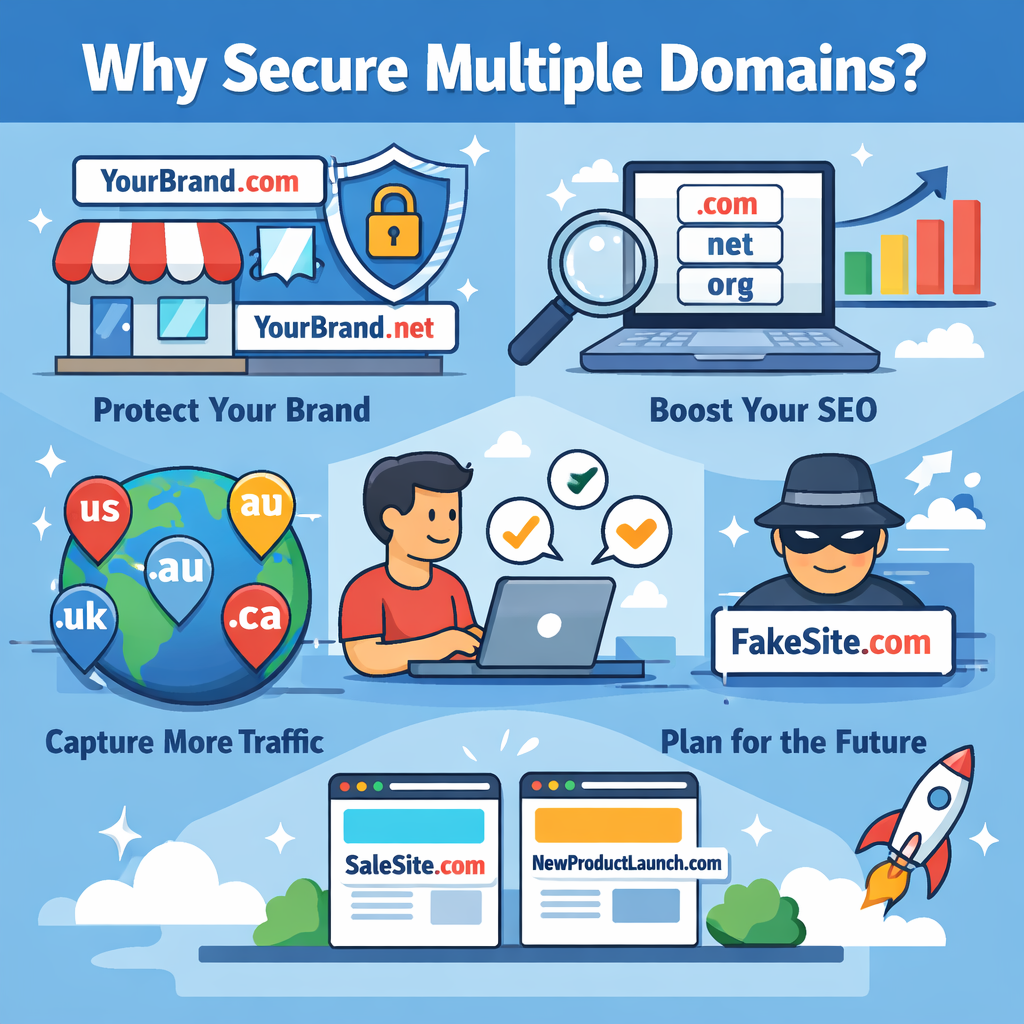
Understanding why secure multiple domains requires looking beyond your primary website. Every unregistered variation of your brand name represents a potential vulnerability, a missed opportunity, or a future regret. From misspellings to geographic extensions, from defensive registrations to strategic SEO plays, the domains you don’t own today could become your biggest headaches tomorrow.
In this comprehensive guide, we’ll explore seven powerful reasons why securing multiple domains should be part of your foundational business strategy. Whether you’re a startup founder, an established SME, or planning your next product launch, the principles we’ll cover will help you build a robust domain portfolio that protects and amplifies your brand.
What Securing Multiple Domains Actually Means
Before diving into the strategic reasons, let’s clarify what we mean by securing multiple domains. This practice involves registering several domain names related to your brand, products, or business strategy—not just your primary .com address.
This portfolio might include:
Common misspellings of your brand name, alternative TLD extensions like .net, .org, .io, or industry-specific options, geographic variants such as country-code domains, product or service-specific domains for future launches, and defensive registrations to prevent cybersquatting or brand confusion.
The cost of domain name registration is minimal compared to the potential costs of brand damage, lost traffic, or legal battles over domain ownership later. Smart businesses view domain portfolio building as insurance, investment, and strategic positioning rolled into one affordable package.
Brand Protection: Stop Competitors From Taking Your Name
One of the most compelling reasons why secure multiple domains centers on brand protection. Your brand identity isn’t just your logo or tagline—it’s the digital territory you occupy in customers’ minds and on the internet.
The Cybersquatting Threat
Cybersquatters actively monitor newly successful brands, registering variations of their domain names with the intent to sell them back at inflated prices or use them to confuse customers. According to ICANN’s Uniform Domain-Name Dispute-Resolution Policy, thousands of domain disputes occur annually.
Consider this scenario: Your business grows from a local operation to a regional brand. Suddenly, a domain squatter registers YourBrand.net, YourBrand.org, and YourBrand.io. They may create misleading websites, sell competing products, or simply hold the domains hostage demanding five or six figures for their release.
Trademark Protection in the Digital Space
While trademark registration offers legal protection, domain names operate in a first-come, first-served system. You might own the trademark, but if someone else owns the domain, you’ll face an expensive legal battle to reclaim it. Prevention costs pennies per day; legal fees start at thousands of dollars.
Securing multiple domains related to your brand creates a protective moat. When someone searches for variations of your business name, they find you—not a competitor, scammer, or domain investor looking to profit from your brand equity.
Protecting Your Reputation
Brand protection extends beyond preventing direct competition. Negative SEO campaigns, parody sites, and complaint forums often use domain names similar to legitimate businesses. By owning YourBrand-Sucks.com or YourBrand-Complaints.net, you prevent these domains from being weaponized against your reputation.
SEO Strategy: Own More Search Space
Understanding why secure multiple domains from an SEO perspective reveals opportunities most businesses overlook. While Google has sophisticated algorithms to prevent domain spam, strategic domain ownership remains a powerful SEO tool when executed properly.
Keyword-Rich Domains for Specific Services
If your main brand is “Acme Solutions” but you offer specialized roofing services, owning AcmeRoofing.com allows you to create targeted landing pages that rank for specific service keywords. Each additional domain in your portfolio can address different customer search intents.
According to Google’s SEO Starter Guide, exact-match domains still carry weight for local and niche searches. While not as dominant as in past years, a well-executed multi-domain strategy can help you own more real estate in search results pages.
Geographic SEO Domination
For businesses serving multiple markets, geographic domains provide powerful SEO advantages. A company operating in Singapore, for example, benefits from securing both their .com and Singapore domain variants (.sg or .com.sg).
Search engines increasingly prioritize local results. When someone in Singapore searches for your services, your .sg domain has inherent advantages in local search rankings. The same principle applies to every geographic market you serve or plan to enter.
Content Segmentation and Niche Authority
Multiple domains allow content segmentation that builds niche authority. Instead of diluting your main site with diverse content topics, you can create focused microsites on separate domains. A financial services company might operate MainBrand.com for corporate services, MainBrandInsurance.com for insurance products, and MainBrandRetirement.com for retirement planning.
Each domain becomes an authority in its niche, potentially outranking the generalist main site for specific queries. This strategy requires substantial content investment but can deliver outsized returns in competitive industries.
Traffic Capture: Misspellings, Variations & Type-in Traffic
Another critical reason why secure multiple domains involves capturing traffic that would otherwise go to competitors or error pages. Real-world user behavior rarely matches ideal scenarios. People make typos, forget exact spellings, and enter domain names based on memory rather than precision.
Common Misspelling Patterns
Every brand name has predictable misspellings. If your business is “Hartwell Industries,” users might type Hartwel, Hartwall, or Hardwell. Each misspelled variant represents potential customers who want to find you but end up at error pages—or worse, competitor sites.
Analyzing your existing traffic sources reveals which misspellings already drive visitors. Register these domains and redirect them to your main site. The annual cost is negligible; the captured traffic compounds over time. Even if each misspelled domain captures just 50 visitors monthly, a portfolio of 10 domains brings 6,000 additional annual visitors.
Type-in Traffic Gold
Type-in traffic—visitors who directly enter domain names into their browser—remains valuable despite the dominance of search engines. This traffic often represents high-intent users with strong brand recall. They’re trying to reach you specifically, not browsing generic search results.
Industry-specific domains capture type-in traffic from users who don’t recall your exact brand but remember your industry. A law firm might secure their-city-lawyers.com, capturing users who type what they need rather than searching. This traffic arrives with zero advertising cost and typically higher conversion rates than cold search traffic.
Alternative TLD Strategy
Beyond the traditional .com, .net, and .org trinity, hundreds of new top-level domains offer branding and traffic capture opportunities. Tech companies gravitate toward .io, agencies use .agency, and professional services explore popular domain extensions aligned with their industry.
Users increasingly accept alternative TLDs. Someone might search for your brand and try YourBrand.io before checking YourBrand.com. If a competitor owns the .io version, you’ve lost that visitor. Securing key alternative TLDs protects against this leakage.
Defensive Domain Ownership: The Silent Business Insurance
Defensive domain registration represents insurance against future problems. Like any insurance, you hope never to need it, but the cost of not having it can be catastrophic. This defensive mindset explains why secure multiple domains even when you have no immediate plans to use them.
Preventing Negative SEO and Brand Attacks
Malicious competitors or disgruntled customers sometimes register domains specifically to damage businesses. They might create complaint sites, parody pages, or deliberately confusing content. The cost to create such a site is minimal; the cost to your reputation can be severe.
By proactively registering negative variations—YourBrand-Complaints, YourBrand-Scam, YourBrand-Sucks—you prevent these attacks before they happen. You control the narrative. Even if you never develop these domains, their defensive value justifies the modest annual renewal fees.
Competitor Blocking Strategy
In highly competitive industries, businesses routinely monitor their competitors’ domain portfolios. When you announce a new product, sharp competitors might race to register related domains, hoping to capture your overflow traffic or confuse your customers.
Defensive registrations block these plays. Before announcing your new product line, secure all relevant domains. This includes the product name combined with common suffixes, your brand combined with the product category, and likely search terms customers will use.
M&A and Corporate Evolution
Businesses evolve through mergers, acquisitions, rebrandings, and pivots. Each transition creates domain name vulnerabilities. Companies often discover too late that their new corporate name’s .com is owned by someone else, forcing awkward domain choices or expensive purchases.
Smart companies anticipate future possibilities. If there’s a 20% chance you’ll rebrand to a particular name in the next five years, securing that domain now costs roughly $50-100. Buying it from a domain investor later might cost $50,000 or more. The math is obvious.
Future Expansion: Protect Your Next Product Before Launch
Forward-thinking businesses understand why secure multiple domains as part of product development and expansion strategy. Every new product, service, or market entry requires digital infrastructure. Domain names are the foundation of that infrastructure.
Product Line Extensions
When planning product launches, domain security should be step one, not an afterthought. If you’re developing a product codenamed “Phoenix,” register Phoenix-related domains immediately. Don’t wait until the launch announcement when competitors and opportunists will flood the domain market with every variation they can imagine.
Product-specific domains serve multiple purposes. They create dedicated landing pages optimized for product keywords, they allow targeted marketing campaigns with memorable URLs, they provide flexibility if the product eventually spins off as a separate entity, and they prevent competitors from creating confusion or capturing your launch traffic.
Geographic Expansion Planning
Global expansion requires more than translating your website. Different markets often demand localized domain strategies. A brand succeeding in the United States should secure country-code domains for target markets before announcing international expansion.
Consider Netflix’s approach. As they entered new markets, they secured local domains, created localized content hubs, and built trust through familiar domain extensions. Your business might not operate at Netflix’s scale, but the principle applies at every level. Understanding what is a domain name and its strategic importance becomes crucial during expansion.
Industry Vertical Targeting
Businesses often start in one vertical and expand into adjacent markets. A company providing software for dentists might expand to veterinarians, optometrists, or physical therapists. Each vertical expansion represents an opportunity to secure industry-specific domains before competitors do.
These domains communicate immediate relevance. A veterinarian searching for practice management software responds better to VetPractice-Software.com than Generic-Software.com, even if the latter offers veterinary features. The domain itself pre-qualifies the traffic and increases conversion rates.
Real Business Scenarios: When Multiple Domains Saved (or Sank) Companies
Theory matters, but real-world examples illustrate why secure multiple domains with urgency. Let’s examine scenarios that demonstrate the stakes involved.
The Startup That Lost Its Name
A technology startup spent two years building their product under the name “Streamline.” They registered Streamline.io but delayed securing Streamline.com, thinking they’d buy it “when we raise our Series A.” The .com owner, seeing the startup’s traction, raised the asking price from $2,500 to $85,000. Unable to afford the premium, the startup had to rebrand entirely—costing six months of momentum and hundreds of thousands in lost productivity and rebranding expenses.
The E-commerce Win Through Misspellings
An online retailer with a slightly unusual brand name analyzed their server logs and discovered that approximately 15% of direct traffic attempts involved misspellings. They invested $200 to register the five most common misspellings and redirected them to their main site. Within a year, those redirects delivered over 45,000 additional visitors who would have otherwise bounced to competitor sites or given up entirely. The return on investment exceeded 22,000%.
The Restaurant Chain’s Geographic Strategy
A regional restaurant chain planning expansion into five new cities secured city-specific domains for each location before announcing their growth plans. When they launched localized marketing campaigns, each city had a memorable, relevant domain. LocalSEO efforts tripled their effectiveness because search engines recognized the geographic relevance. The domains cost less than $300 total but generated an estimated $250,000 in additional revenue through improved local search visibility and targeted campaigns.
The Defensive Registration That Prevented Disaster
A financial services firm routinely registered defensive variations of their brand, including complaint-related domains. When a disgruntled former employee attempted to launch an attack site, they discovered all negative domain variations were already owned by the company. Unable to secure a relevant domain, the attack fizzled before gaining traction. The company estimates this defensive strategy, costing less than $500 annually, prevented potential reputation damage that could have cost millions in lost business.
How Many Domains Should You Secure?
Understanding why secure multiple domains naturally leads to the question: how many is enough? The answer depends on your business size, industry, budget, and growth trajectory. However, some baseline recommendations apply across scenarios.
Minimum Viable Portfolio
Every business should start with a minimum viable domain portfolio including their primary .com domain, the .net and .org equivalents (preventing confusion), the most common misspelling of their brand name, and if applicable, their country-code TLD for their primary market.
This baseline portfolio typically costs $100-200 annually and provides essential protection. It prevents the most obvious problems without requiring significant investment. Understanding the domain name life cycle helps you manage renewals efficiently.
Growth-Stage Portfolio
As businesses grow, expand the portfolio to include keyword-rich domains for major products or services, geographic domains for each market you serve, the top 5-10 misspelling variations, defensive registrations for negative terms, and alternative TLDs relevant to your industry (.io for tech, .agency for agencies, etc.).
A growth-stage portfolio might include 15-30 domains, costing $500-1,500 annually. This represents a tiny fraction of most marketing budgets while providing substantial strategic value.
Enterprise-Level Domain Strategy
Established companies and those with significant brand value should maintain comprehensive portfolios including all major TLD variants, comprehensive misspelling coverage, product and service-specific domains, complete geographic coverage for all markets, defensive registrations including all conceivable negative variations, and strategic domains for potential future use.
Enterprise portfolios often exceed 100 domains. While this seems excessive, the cost remains manageable (typically $3,000-10,000 annually) compared to the enterprise’s overall budget and the risks these domains mitigate. You can explore domain transfer options to consolidate management and reduce costs.
Industry-Specific Considerations
Certain industries demand more aggressive domain strategies. Legal firms, financial services, healthcare, and other regulated industries face higher reputation risks, making defensive domains particularly valuable. E-commerce businesses benefit more from typo domains than service businesses. Geographic domains matter more for businesses with physical locations.
Assess your industry’s unique risks and opportunities. A small local bakery has different domain needs than a national software company, which has different needs than an international manufacturer.
Common Mistakes to Avoid When Securing Multiple Domains
Understanding why secure multiple domains is step one. Executing the strategy properly requires avoiding common pitfalls that undermine your efforts.
Mistake #1: Waiting Too Long
The single biggest mistake is delaying domain registration until you “need” them. Domain markets move quickly. The perfect domain available today might be gone tomorrow. The asking price low today might be 100x higher next year. Register strategically important domains immediately, even if you won’t use them for years.
Mistake #2: Inconsistent Ownership Records
Maintaining domains under different registrars or ownership records creates management headaches and security vulnerabilities. Consolidate your domain portfolio under one registrar with consistent ownership information. This simplifies renewals, improves security, and makes bulk management possible. Consider who truly owns your domain name from a legal and administrative perspective.
Mistake #3: Neglecting Renewals
Allowing domains to expire is catastrophic. Domain investors monitor drop lists, swooping up valuable expired domains within minutes. Enable auto-renewal on all strategic domains. Set calendar reminders. Treat domain renewals with the same importance as insurance premiums—because that’s what they are.
Mistake #4: Over-Optimization and Spam Tactics
While multiple domains offer SEO advantages, creating thin content across dozens of domains triggers Google’s spam filters. Each domain you develop should provide genuine value. Redirected domains are fine; low-quality microsites that exist solely for link building are not. Follow search engine guidelines or risk penalties that harm your entire web presence.
Mistake #5: Ignoring Legal Considerations
Registering domains that infringe on others’ trademarks invites legal trouble. Before registering a domain, conduct basic trademark searches. Defensive registrations of your own brand are legal; registering competitors’ brand names hoping to profit is not. Understand the legal boundaries to avoid costly disputes.
Mistake #6: Poor Documentation
Years pass, employees change, and memories fade. Without proper documentation, you might forget why you own certain domains or what strategic purposes they serve. Maintain a spreadsheet documenting each domain’s purpose, renewal date, redirect target (if applicable), and strategic value. This prevents accidental cancellations and ensures continuity during business transitions.
Final Strategy Guide: Implementing Your Multi-Domain Approach
Now that you understand why secure multiple domains, let’s outline a practical implementation strategy that works for businesses at any stage.
Step 1: Audit Your Current Domain Portfolio
Begin by inventorying all domains currently under your control. List each domain, its purpose, renewal date, and annual cost. Identify gaps in your coverage—missing TLDs, unregistered misspellings, or geographic variants you should own.
Step 2: Prioritize Strategic Acquisitions
Not all domains deserve equal priority. Create a tiered list ranking domains by strategic importance. Tier 1 includes essential brand protection domains you should acquire immediately regardless of cost (within reason). Tier 2 includes valuable domains worth acquiring if available at reasonable prices. Tier 3 represents nice-to-have domains you’ll acquire opportunistically.
Focus resources on Tier 1 acquisitions first. Don’t let a $500 Tier 2 domain distract you from securing a $20 Tier 1 domain that’s critically important.
Step 3: Set Budget Parameters
Establish clear budget parameters for domain acquisitions and renewals. What’s the maximum you’ll pay for a premium domain? What’s your total annual renewal budget? How much will you allocate for opportunistic acquisitions versus planned strategic purchases?
Budget frameworks prevent emotional overspending while ensuring you invest adequately in this critical business infrastructure.
Step 4: Implement Consistent Management Systems
Choose a reliable domain name registrar and consolidate your portfolio there. Enable two-factor authentication, set up auto-renewal, and configure expiration alerts. Treat domain security with the same rigor you apply to financial accounts—because domains are valuable business assets.
Step 5: Create Redirect and Development Plans
For each domain in your portfolio, document its intended use. Will it redirect to your main site? Will it host a microsite? Will it remain parked defensively? Having a clear plan ensures domains serve their strategic purpose rather than languishing unused.
Step 6: Monitor and Adapt
Domain strategy isn’t set-and-forget. Regularly review your portfolio, adding new domains as your business evolves and dropping any that no longer serve strategic purposes. Monitor trademark registrations in your industry to identify potential conflicts. Stay informed about new TLD launches that might offer branding opportunities.
The Long-Term Perspective
Domain portfolios are long-term assets that appreciate as your brand grows. The $15 domain you register today might be worth $15,000 in five years—not because you’ll sell it, but because defending against brand attacks or buying it from a squatter would cost that much or more.
View domain registration through this long-term lens. The annual cost is minimal. The cumulative protection compounds over time. The strategic optionality increases as your business grows.
Conclusion: Why Secure Multiple Domains is Non-Negotiable for Serious Businesses
We’ve explored seven powerful reasons why secure multiple domains should be foundational to your digital strategy. From brand protection to SEO advantages, from traffic capture to future-proofing your expansion plans, the case for maintaining a robust domain portfolio is overwhelming.
The question isn’t whether to secure multiple domains—it’s how many and which ones deserve priority. Start with the minimum viable portfolio protecting your core brand. Expand strategically as your business grows. Think defensively about reputation risks and offensively about market opportunities.
Most importantly, act now. Every day you delay is a day competitors, domain investors, or opportunists might register domains that should belong to you. The cost of prevention is measured in dollars. The cost of remediation is measured in thousands or tens of thousands. The cost of losing your brand’s digital territory to bad actors? That’s often incalculable.
Start building your domain portfolio today. Your future self will thank you for the foresight, your marketing team will benefit from the strategic flexibility, and your brand will stand protected in an increasingly complex digital landscape.
For comprehensive guidance on managing your domain portfolio, explore additional resources on domain registration best practices, DNS management, and digital brand protection strategies. The investment you make today in securing multiple domains will pay dividends throughout your business’s lifetime.