
Introduction: Why Domain Control Confusion Costs Businesses Millions
Every year, thousands of businesses lose control of their domains not because they forgot to renew them, but because they fundamentally misunderstood who actually controlled them. The distinction between registry vs registrar vs reseller represents the chain of custody for your most critical digital asset.
Most business owners believe they bought their domain from a registry. They did not. Others think their web hosting company owns their domain infrastructure. The confusion stems from a three-tier system that creates dangerous blind spots for anyone who does not understand where control actually resides.
This article eliminates that confusion completely. You will understand exactly who controls what at each layer, where failure points exist, and why casual decisions can result in permanent loss of your digital identity.
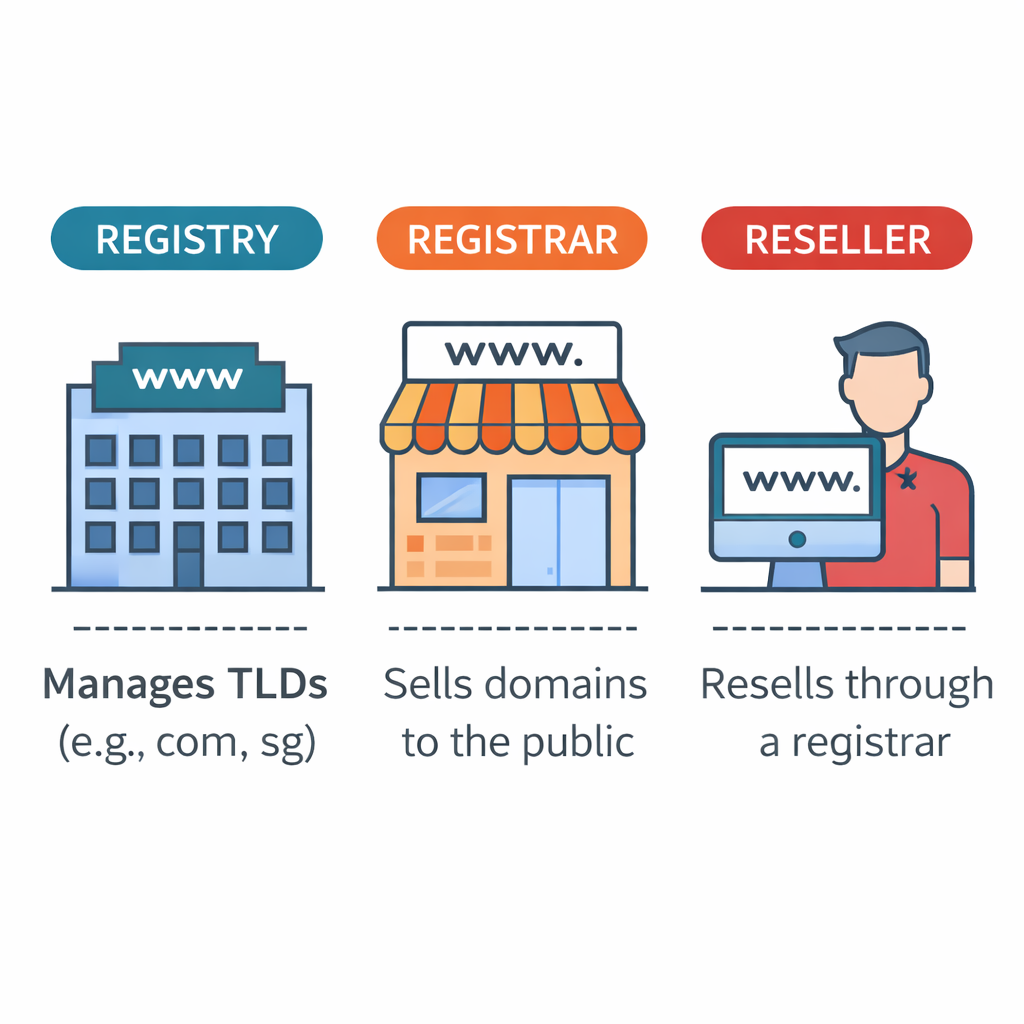
The Three-Tier System: Visual Logic You Can Remember
The best way to understand the registry vs registrar vs reseller relationship is through a physical-world analogy that maps perfectly to domain infrastructure.
Think of vehicle ownership. The registry is the government’s vehicle registration authority. It maintains the master database of who owns which vehicle. You cannot walk into this authority and buy a car directly. The registrar is the licensed car dealership that can process your purchase and register the vehicle with the authority on your behalf. The reseller is the sales agent within that dealership who handles your transaction but has no independent registration authority.
In the digital world, this maps precisely. The registry maintains the authoritative database for all domains under specific extensions like .com or .org. The registrar is an ICANN-accredited organization that can register domains with the registry on your behalf. The reseller is a company that uses a registrar’s infrastructure to sell domains but has no direct relationship with the registry.
Here is the critical distinction most people miss: at no layer do you ever own the domain outright. You lease the right to use it, and that lease exists in the registry’s database. Your relationship with a registrar or reseller determines only how easily you can modify that lease, transfer it, or maintain control when problems arise.
| Layer | Role | Authority Level | Customer Access | Failure Impact |
|---|---|---|---|---|
| Registry | Maintains master database | Absolute authority | No direct access | All domains in TLD affected |
| Registrar | Processes registrations with registry | ICANN-accredited intermediary | Direct customer relationship | Portfolio can be transferred |
| Reseller | Sells using registrar infrastructure | No registry or ICANN relationship | Branding layer only | Customers must migrate to new provider |
Understanding this hierarchy explains why certain problems occur and why others are impossible. The registry does not care which registrar you use, only that the registrar is accredited. The registrar does not care which reseller brought you in, only that someone is paying for the domain lease. When failures happen, your position in this chain determines whether recovery is straightforward or catastrophic.
Registry Explained: The Single Source of Truth
A domain registry operates the authoritative database for a specific top-level domain extension. Verisign operates the registry for .com and .net domains. Each country code like .sg or .uk has its own registry operator. These organizations maintain the master records that determine which domain names exist and who controls them.
The registry does exactly three things. First, it maintains the database of all registered domains under its extension. Second, it operates the DNS infrastructure that makes those domains resolve globally. Third, it enforces policies about registration requirements, transfer procedures, and domain lifecycle management.
What the registry does not do is equally important. It does not sell domains to end users. It does not provide customer support. It does not set retail pricing. The registry charges registrars a fixed wholesale fee, typically between six and ten dollars per domain per year. Everything else in the price you pay flows to intermediaries or represents markup.
This is why you cannot buy a domain directly from Verisign even though Verisign controls the .com registry. The registry operates wholesale infrastructure, contracting only with accredited registrars who meet technical and financial requirements.
The registry holds absolute authority within its namespace. If a court orders a domain transfer, the registry executes it. If a registrar loses accreditation, the registry forces migration of that registrar’s domain portfolio. No registrar can override registry decisions, which is why understanding registry vs registrar vs reseller hierarchy matters when legal disputes or compliance requirements emerge.
At QOXY, we often explain to clients that while they interact with us as their registrar, the registry is the ultimate custodian of their domain’s existence. We can update your nameservers or manage your renewal, but we cannot alter the fundamental rules that the registry imposes, including transfer lock periods, redemption grace periods, and authentication requirements that protect domain ownership.
The registry’s role creates an important protection mechanism. Because registries operate independently of retail sales, they serve as neutral arbiters when disputes occur. If your registrar becomes unresponsive or goes out of business, the registry data proves ownership.
Registrar Explained: Your Direct Interface to Domain Control
A domain registrar is an organization that has met ICANN’s accreditation requirements and maintains a direct technical and contractual relationship with domain registries. When you register a domain through a registrar, that registrar communicates with the registry to create the registration record, updates the registry when you modify DNS settings, and processes renewals and transfers according to registry and ICANN protocols.
Registrars serve as the operational layer between end users and registry infrastructure. They provide the account systems you log into, the control panels where you manage DNS records, the billing systems that process renewals, and the support teams that answer questions.
What makes a registrar different from other companies selling domains is accreditation. ICANN requires registrars to maintain specific financial reserves, implement security measures, provide dispute resolution mechanisms, and comply with consensus policies. Not every company selling domains is a registrar—most are resellers using a registrar’s infrastructure.
The registrar controls several critical functions. First, they manage your access credentials and recovery procedures. Second, they implement security features like two-factor authentication, transfer locks, and DNSSEC. Third, they determine how quickly you can make changes to DNS or initiate transfers.
Registrar choice affects more than price. It affects how easily you can transfer domains to another provider, how responsive support is when problems occur, and how robust security protections are. This is why ICANN’s transfer policy exists—to prevent registrars from holding domains hostage.
The relationship between registry vs registrar becomes most visible during transfers. When you initiate a transfer to a new registrar, the losing registrar must provide an authorization code within a specific timeframe. The registry verifies the code and executes the transfer. Neither registrar can block the transfer once proper authorization is provided.
This is why QOXY treats domain control as a fundamental customer right rather than a retention mechanism. We provide authorization codes immediately and process transfers out as quickly as transfers in. When registrars create artificial barriers to transfer, they are violating ICANN policy.
Understanding what your registrar controls versus what the registry controls becomes critical during failure scenarios. Your registrar controls your login credentials, your payment methods, and your DNS management interface. The registry controls the authoritative record of ownership and the ultimate approval of transfers.
Reseller Explained: The Convenience Layer with Hidden Dependencies
A domain reseller operates under a registrar’s infrastructure without having direct accreditation from ICANN or direct relationships with registries. Web hosting companies, website builders, and marketing agencies often act as resellers, offering domain registration as a bundled convenience rather than a core service.
Resellers exist because building a fully accredited registrar operation requires significant technical investment, financial reserves, and ongoing compliance costs. The reseller model allows companies to white-label a registrar’s infrastructure without maintaining registry connections or ICANN reporting.
When you register a domain through a reseller, several layers of abstraction exist between you and actual control. You interact with the reseller’s interface, which submits your order to their parent registrar’s API. The parent registrar communicates with the registry. Your WHOIS record shows the parent registrar, not the reseller.
The most critical limitation is that resellers cannot process transfers independently. If you want to move a domain away from a reseller, you must first identify the underlying registrar, obtain the authorization code through that registrar’s procedures, and transfer to a new registrar. If the reseller’s relationship with the parent registrar ends, your access to domain management may disappear instantly.
This dependency creates significant risk. When a reseller goes out of business, domains do not automatically transfer to customers. They remain with the parent registrar under the reseller’s account structure. Customers must prove ownership and request that the parent registrar provide transfer codes—a process that can take weeks or months.
Resellers make sense in specific contexts. If you are buying an all-in-one website package where the domain is a small component and you plan to stay with that provider long-term, reseller convenience may outweigh dependency risks. For single domains on small personal projects, the simplified interface may be adequate.
Resellers do not make sense when control and portability matter. If your domain represents your primary business identity, you need direct registrar access. If you manage multiple domains or anticipate needing to transfer them, you need to avoid reseller dependencies. If you operate in a regulated industry where domain ownership verification may be required, you need clear documentation.
The registry vs registrar vs reseller distinction matters most at the reseller layer because this is where confusion is highest and risks are least visible. Many businesses do not realize they are using a reseller until they try to transfer a domain and discover they cannot contact the actual registrar.
Failure and Risk Scenarios: What Actually Breaks
Understanding the registry vs registrar vs reseller structure becomes most critical when something goes wrong. Each layer has different failure modes, different recovery procedures, and different impacts on your ability to maintain domain control.
Scenario One: Registrar Loses Accreditation or Shuts Down
When a registrar loses ICANN accreditation or ceases operations, the registry does not delete the domains. They remain registered and continue to resolve. What breaks is your ability to manage them. Your account credentials stop working. The control panel becomes inaccessible.
What stays intact is the registry data. Your domain still exists. The WHOIS record still shows you as the registrant. DNS records continue resolving. The expiration date does not change. Domain functionality and domain management are separate.
ICANN provides mechanisms for this scenario. Affected domain owners receive notification at their WHOIS contact email and can approve transfer to a designated successor registrar. This is why maintaining current WHOIS contact information matters.
Scenario Two: Reseller Disappears
When a reseller ceases operations, the failure is less structured because resellers are not directly governed by ICANN. Your domains remain with the underlying registrar, but your access through the reseller’s interface vanishes. The reseller’s support stops responding. The control panel goes offline.
You must research the WHOIS record to identify the underlying registrar, contact their support, and prove you own the domains. You must establish a new direct account or transfer the domains to a different provider—but first you must convince the registrar to give you the authorization codes.
This scenario is more common than registrar failures because reseller business models are less stable. Web hosting companies and marketing agencies close regularly, and none face the regulatory oversight that registrars do.
Scenario Three: Registry Lock or Ownership Dispute
When legal disputes or fraud allegations involve a domain, the registry can place status codes that prevent transfer or modification. ServerHold stops the domain from resolving. ClientTransferProhibited blocks transfers. Your registrar cannot override these locks.
This is why DNS and nameserver configuration should be documented externally. If a domain becomes locked, you cannot retrieve settings from a management panel. Registry-level locks are rare but catastrophic when they occur.
Scenario Four: Registrar Refuses to Provide Authorization Code
Some registrars implement policies that delay or complicate transfers. They may require manual support requests for authorization codes or impose artificial waiting periods beyond ICANN policy. These practices violate ICANN’s Transfer Policy, but enforcement depends on customers knowing their rights and filing complaints.
ICANN’s Transfer Dispute Resolution Policy provides a formal complaint mechanism. If a registrar refuses to provide authorization codes without legitimate cause, you can file a complaint. ICANN can force the registrar to comply or impose sanctions.
If you are dealing with a reseller, filing complaints against them accomplishes nothing because they have no ICANN obligations. You must identify and complain against the underlying registrar.
Where QOXY Fits: Domain Control as a Fundamental Right
When you register or transfer a domain to QOXY, you have a direct access to what a registrar system has.
We approach domain management from a perspective that control belongs to the customer. This means we provide authorization codes immediately when requested, process transfers in and out with equal efficiency, and do not implement artificial lock periods beyond what registries and ICANN require.
At QOXY, we often see clients arriving from failed resellers or unresponsive registrars with stories of being locked out of their own domains. These scenarios are preventable when the registry vs registrar vs reseller structure is transparent and control is treated as a customer right rather than a retention mechanism.
Final Clarity Checklist: The Mental Model You Need
After understanding the complete registry vs registrar vs reseller structure, you should be able to answer these questions clearly:
- Who maintains the authoritative database of my domain? The registry that operates the top-level domain extension. For .com, this is Verisign. You never have direct contact with the registry.
- Who do I have a contractual relationship with? Your registrar if you registered directly, or a reseller if you registered through a hosting company or bundled service. Check your WHOIS record to identify the registrar of record.
- Who can I demand an authorization code from? Your direct registrar. If you used a reseller, you must identify the underlying registrar. ICANN policy requires registrars to provide codes, but does not govern resellers.
- What happens if my registrar fails? The registry preserves your domain data. ICANN coordinates transfer to a new registrar. Your domain continues resolving but management access is temporarily disrupted.
- What happens if my reseller fails? You must contact the underlying registrar, prove ownership, and either establish direct access or transfer to a new provider.
- Can a registrar prevent me from transferring my domain? Only for legitimate reasons like recent registration or payment disputes. If a registrar refuses transfer without valid cause, you can file an ICANN complaint.
- Do I own my domain outright? No. You lease the right to use it from the registry through a registrar. Ownership is a conditional right that renews annually or for longer periods.
The registry vs registrar vs reseller structure exists because domain infrastructure requires both centralized authority and distributed service delivery. The registry provides authoritative data. The registrar provides customer-facing operations. The reseller provides convenience for customers who prioritize simplicity over control.
Understanding this hierarchy transforms domain management from a confusing technical process into a clear custody chain. When you know who controls what, you can evaluate whether your current arrangement protects your interests. When you understand where failure points exist, you can take preventive action.
The stakes are not abstract. Domains are how customers find you, how email reaches you, and how business continuity is maintained. Treating domain registration as a commodity purchase without understanding the registry vs registrar vs reseller relationships is how businesses lose control of their digital assets.
If you are registering a new domain, choose a direct registrar with clear ownership policies. If you are managing existing domains through a reseller, verify who the underlying registrar is and consider migrating to direct control. If you are evaluating providers, ask whether they are an ICANN-accredited registrar or a reseller.
The registry provides the database. The registrar provides the interface. The reseller provides the convenience. Your job is to know which layer you are dealing with and what that means for your control, your risk, and your ability to make changes when needed.